The emergence and growth of international human rights law.
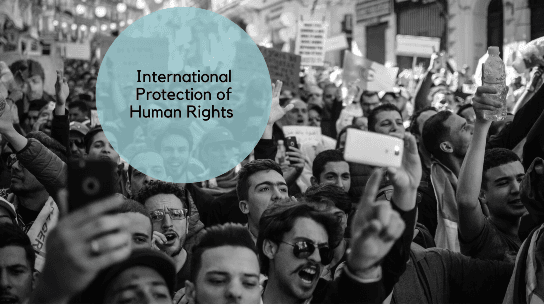
Explore the dynamic field of International Protection of Human Rights. This course examines the remarkable emergence and growth of human rights as a central pillar of modern international law, challenging traditional notions of state sovereignty by establishing rights for individuals and groups opposable against states.
We delve into the foundational developments, tracing the evolution from early precursors to the landmark United Nations Charter and the Universal Declaration of Human Rights. Understand how these instruments paved the way for formal recognition of individual entitlements on the international stage.
The course analyzes the key universal treaty regimes, including the International Covenant on Civil and Political Rights (ICCPR) and the International Covenant on Economic, Social and Cultural Rights (ICESCR). Learn about the different generations of rights, the debates surrounding their nature and implementation, and the development of specialized human rights conventions.
Examine the role of complementary regional human rights systems, such as those in Europe, the Americas, and Africa, investigating their unique features, strengths, and limitations in defining and protecting human rights compared to the universal framework.
Finally, the course addresses contemporary challenges and points of contention. We discuss issues like the interpretation of universal norms in diverse cultural contexts and, critically, the persistent difficulties in establishing effective compliance and enforcement mechanisms to ensure state accountability for human rights violations.
Gain essential familiarity with the overall international human rights framework, understanding its historical trajectory, core principles, key institutions, and the ongoing struggles to translate recognized rights into lived reality worldwide.
https://twitter.com/irwinlaw
Books on law do not need to be difficult, dull, and costly. At Irwin Law Inc., our aim is to produce books of exceptional quality at affordable prices. We are determined to produce books that are modern, lively, and interesting, as well as clearly organized and attractively designed, at prices substantially lower than our competitors. Indeed, our books are accessible to students and legal practitioners alike, while maintaining the highest standards of excellence. As Canada's youngest law publisher, Irwin Law brings an innovative approach and fresh ideas to legal publishing. The company was established in 1996 - very recently in an industry whose roots go back to 1855. At its inception, Irwin Law Inc. was affiliated with the Stoddart Publishing Group. In 1999, Irwin Law was purchased by Quicklaw, Canada's leading online legal research service. The purchase was a natural, as Irwin Law had been among the first publishers to make its books available on the online database. However, when Quicklaw was purchased by LexisNexis Group in July 2002, Irwin Law needed to find new owners. The company was purchased by a small group led by Irwin Law's founding publisher, Jeffrey Miller. From its beginning, Irwin Law has strived to publish books that do more than outline the current state of the law. They analyze the complex issues of the day in a succinct and readable style and in a manner that is probing and thoughtful. Our books are accurate, comprehensive, and up-to-date. Indeed, all manuscript submissions are subject to peer review and our authors are among the leading law practitioners and professors in Canada and the world. Irwin Law brings to the marketplace books that whet the reader's curiosity, challenge established tradition, and create intellectual excitement.

John h. Currie is a law professor in the Faculty of Law at the University of Ottawa, where he teaches international law, the use of force by states, the law of armed conflict, torts, and constitutional law. He has degrees from the Universities of Toronto, Ottawa, and Cambridge, and litigated for several years with Lang Michener LLP in Toronto and Ottawa. From 2004 to 2006, Professor Currie was Scholar in Residence in the Legal Affairs Bureau of Canada’s Department of Foreign Affairs and International Trade where he worked primarily on international criminal and humanitarian law issues. In that capacity, he represented Canada before a number of UN and other bodies, including the International Criminal Tribunal for the Former Yugoslavia. An Assistant Editor of the Canadian Yearbook of International Law and Past-President of the Canadian Council on International Law, Professor Currie is the author or co-author of seven books, including (with Professors Craig Forcese and Valerie Oosterveld) International Law: Doctrine, Practice, and Theory (Irwin Law, 2007). His research interests include the use of force by states, international humanitarian law, extraterritorial jurisdiction, the domestic reception of international law, maritime boundary delimitation, and international criminal law.
