Master the new era of dispute resolution as mediation and arbitration shed their alternative status to become the undisputed primary standard for modern legal practice.
Alternative dispute resolution is now a core component of Canadian legal practice. Courts increasingly expect counsel to consider and meaningfully engage in mediation and arbitration, and clients look to their lawyers for strategic guidance on selecting appropriate dispute resolution processes.
This webinar provides a practical overview of the role of ADR in modern Canadian law. Participants will examine how mediation and arbitration are used in practice, how courts approach ADR, and how lawyers can effectively advise clients on dispute resolution strategy. Drawing on extensive experience in Canadian and international ADR, the session focuses on professional competence, procedural understanding, and risk-informed decision-making.

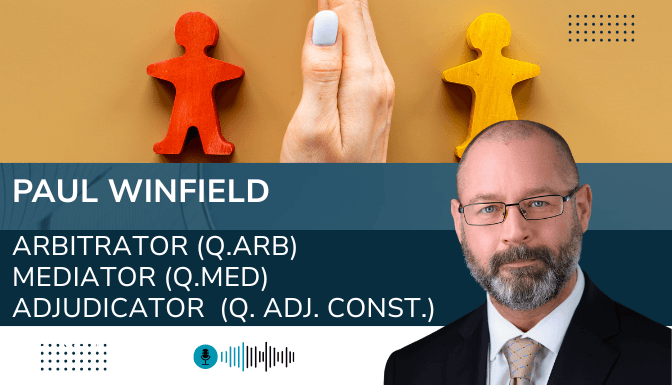
Arbitrator (Q.Arb), Mediator (Q.Med), Adjudicator (Q. Adj. Const.)
Paul is both a federal (CanDACC) and provincial adjudicator, since 2020 he has had over 40 appointments with ODACC, ARCANA, SCDRO and the Ontario Ministry of Transportation. He is a panel member with ADR Chambers in Toronto and is a ADRIC/RICS Qualified Adjudicator and Qualified Mediator. With over 35 years’ construction experience, Paul’s career progressed from office junior and site quantity surveyor to claims consultant, in-house counsel, director, and 3rd party neutral. Paul has represented both contractors & owners, operating at every level of the construction pyramid on a range of contracting strategies including lump sum, cost reimbursable, target cost and the PPP/PFI environment. His experience includes a variety of bespoke and standard form contracts including CCDC, FIDIC, NEC, ICE and JCT contracts on transportation and infrastructure, oil & gas pipelines and installations, process plants, utilities (water, gas and power), airports, nuclear facilities and commercial developments, from inception to commissioning to final completion and close-out. Paul’s commercial expertise includes project commercial management, contract drafting and negotiation, risk and opportunity management, contract administration, project controls, and procurement. Paul has acted as expert witness in various contract and commercial disputes. Paul has also personally represented numerous owners and contractors in contract negotiation and adjudication and has assisted counsel in a variety of ADR forums worldwide. His adjudication expertise includes claims identification, preparation, articulation and advocacy. Subsets of that expertise include forensic quantum and delay analysis. Paul was called to the bar of England and Wales and qualified as an arbitrator in 2010, he is a member of the Honourable Society of the Inner Temple, and a fellow of the Chartered Institute of Arbitrators. Paul’s work was published, with contributions to ‘Introduction to Construction Contract Management’ by Routledge. Paul is perfectly placed to understand the context and circumstances of a construction dispute. He knows what it takes to provide a compelling and substantiated claim, juxtaposed with the inherent limitations that the construction industry creates.
